Falling Up the Staircase: A Review of GEB Godel, Escher, Bach
I started reading this book in October 2025. It was a chunky little (not little) thing to get through, and only after having simmered in my thoughts for a while can I say that now I have actually finished Gödel, Escher, Bach. The way I would describe sitting with this book would be like having a gigantic meal that was too big, except the fullness is in your head instead of your stomach. A break was important because the book didn’t end when I closed it, it unfolded in the shower, on walks, while talking to friends, before I slept, etc. So I figured I'd try to write some of it down, partly to share it and partly to figure out what I actually think. I went in expecting a book about three people – a logician, an artist, and a composer. I came out realizing it was never really about them at all.
So what’s the book about?
On the surface, Hofstadter is juggling a lot. There's Bach and his fugues, where a single melody chases itself, flips upside down, stretches out, and stacks on top of copies of itself. There's Escher and his impossible drawings, hands drawing the hands that draw them, water flowing downhill forever until it somehow arrives back at the top. There's Gödel and his famous theorem, which I'll admit took me a long time to actually grasp, and even now I only understand its relevance theoretically / unmathematically.
But underneath all of it, the core idea is the same: things that loop back on themselves. Melodies that refer to themselves. Pictures that contain themselves. A mathematical system that somehow learns to talk about itself. Hofstadter gave a name for this special kind of loop, and once I learned it I started seeing it everywhere. It’s called a strange loop.
You might ask, well what’s strange about it? So let me know you, but please, the following thing you cannot simply understand. You have to try and feel it.
A normal loop is boring. A spiral staircase goes around and around, but you always know you're on a staircase. You can point to "up" and "down" with confidence. But a strange loop… it’s paradoxical and it messes with you. When you think you keep moving in a single, honest direction, always climbing, going up a higher level on the steps, suddenly you somehow end up exactly where you started. That, my friends, is a strange loop. Escher's Waterfall is the picture you could reference here. Follow the water and every single segment flows downhill, obediently, sensibly, expectedly; but trace the whole path and it loops back to the top, which should be impossible. Every local step is fine. The whole thing is a paradox. Hofstadter calls this a tangled hierarchy: a system of levels where the top and the bottom turn out to be secretly stitched together. You think there's a ladder. There's actually a knot. Boom.
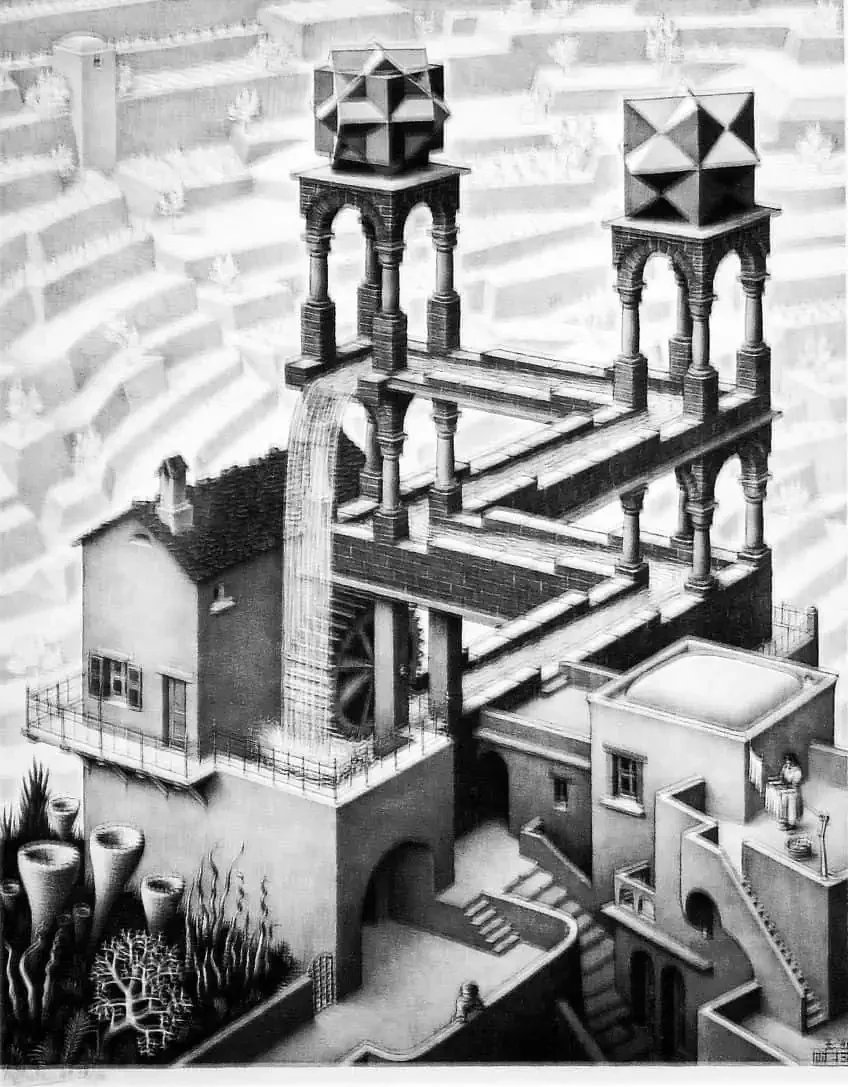
Waterfall by M.C. Escher
The true meaning behind everything
Most of the book feels like an elegant intellectual game. I won’t lie, I did gloss over many parts because I felt like they took away from the central philosophical idea (for me), but that’s my shortcoming. For anyone else, I think it’s worth a read, and do it the way you like it. Anyway, for most of the book, I felt like I was learning a lot, thinking of little things. Beautiful patterns. Clever dialogues between Achilles and the Tortoise. A puzzle here, a fugue there. I was enjoying it.
But then things clicked and I enjoyed it so much more, I can’t even express it (I will now).
The argument goes something like this. Your brain, at its lowest level, is just neurons firing. Pew pew pew pew pew. There's no "you" in a neuron, kind of the same way there's no meaning in a single letter of the alphabet. It's all meaningless machinery, physics doing physics, bio doing bio, chem doing chem. You get the idea. But our brain is powerful enough to build symbols, like a symbol for "tree”, "my mother”, “love”. So obviously, any brain rich and foldy enough is eventually going to build a symbol for the one thing that's present in every single experience it ever has. Itself. It builds a symbol for "I." And that's where the loop goes strange! In the most simple, TLDR summary: that I isn't sitting up above the neurons, directing traffic like a captain. It's made of the very neural activity it seems to be bossing around. The neurons build up into the feeling of a self, and the self feels like it's reaching down to push the neurons around. I decided to raise my arm. But the "I" that decided is itself just a pattern in the machinery doing the raising. Daaaaaaaaaaaamn.
I feel like I’m not doing justice to the idea. It’s way cooler in my end. Okay, so imagine two arrows. First, we have an arrow pointing up. This arrow is about how the small, mindless stuff creates the big, meaningful stuff. Our little neurons fire a billion times and out of those firings, the feeling of "me" emerges. That’s how the parts build the whole, and this direction feels obvious and scientific, of course the brain makes the mind, like little lego blocks that build the lego model. Now think about the arrow pointing down, this is to explain how the big, meaningful stuff controls the small stuff. I decide to raise my arm, and the neurons obey. I decide to eat 41103841 chocolates, and I do. I choose to hug a friend. I seem to make choices to make my body move and do things. Etc. etc. etc. The whole commands the parts. This direction feels obvious and personal too, of course I'm the one in charge of my own body.
Okay, so, now each arrow seems completely true on its own, but the strangeness is that they point in opposite directions, and yet both are happening at once. The neurons make the "I," and the "I" seems to push the neurons.
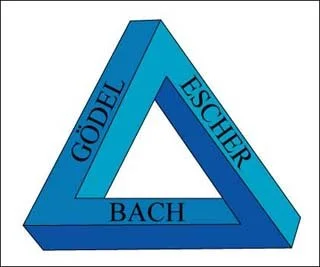
The Penrose Triangle
Also known as the tribar, is an impossible object. It appears to be a solid triangle made of three straight beams of square cross-section which meet at right angles. It is featured prominently in the works of artist M.C. Escher, whose earlier depictions of impossible objects partly inspired it. (Image and description by MIT OCW)
The natural way to think of the paradox is to imagine the I as something separate, like the captain standing on the deck, looking down at the crew of neurons and (politely) shouting orders. If there were a captain, the two arrows would make sense, because the captain is a different thing from the ship, so of course it can steer it. But when you actually look for the captain, there's nobody there. Open up the brain but you will find only the crew, only neurons, all the way up, all the way down. So, the unsettling conclusion is this: The "I" isn't standing above the neurons giving orders. The "I" is made out of the same neurons it seems to be ordering around. In other words, the captain is not a person on the ship. The captain is just a particular pattern in how the crew is moving. When we say "I decided to raise my arm," the deciding "I" and the neural activity doing the raising aren't two things, like a boss and a worker. They're one thing seen from two angles. The pattern feels like a commander to itself but it's really just the crew organized in a loop that includes a model of the one giving orders.
Goosebumps?!?!?! Sorry for the word vomit.
The Godel piece that ties in consciousness
Why was Gödel was in the title at all? He took mathematics which is a system of rules shoving meaningless symbols around, and found a way to write a statement, inside that system, that referred to itself. Roughly: "this statement cannot be proved." It is true, but it is false. It is false, but it is true. An otherwise bulletproof system ended up containing a thought about the whole system, including itself, meaning it folded back on its own structure. And Hofstadter's claim that the entire 700-page golden eternal braid has been building toward is therefore very simple: Consciousness is that exact same trick, just performed in neurons instead of in numbers. In other words, a system complex enough to model the world will, sooner or later, fold back and start modeling itself. And that fold / self-referential loop / knot in the hierarchy is what it feels like from the inside to be a mind, to be an I.
Let that sink in
So what is the self, in this view? It’s argued that it is a pattern, a self-referential loop the brain draws around itself and keeps redrawing, moment after moment, for as long as we’re alive. For me what’s cool is that the book did the thing it set out to do, it made me catch myself in the act of being a self, and made me notice, for just a second, the staircase curving back on itself beneath my feet. And then, of course, the moment passed, and I was just me again, climbing “up”.
Final thoughts
Sometimes I get mad at myself for not putting more effort into my writing. I never plan ahead, and just dump whatever’s on my mind into this space. There is so much more to this book I haven’t captured, so much more nuance, more notes on the math that is literally the foundation behind all of this, and yet I have left it so bare. I apologize for this, I am, it seems, lazy. Sorry. Please do justice to this book and its ideas by reading more on it. Maybe I’ll compile a list.
Thanks for reading!! :)
Some cool links to check out that I’ve collected over the months in my attempt to learn more about this:
Escher's "Relativity" in LEGO: it's a build log / show-and-tell page from the early 2000s about translating one of Escher's impossible-looking artworks into real photographable LEGO. It was really hard to do it seems, because it wasn’t an optical illusion but a real thing, and the key was in the angle of the photograph being taken. For context, "Relativity" is the Escher print where staircases run in impossible directions and little figures walk around with gravity pulling in three different directions at once.
More context on the above series https://www.birs.ca/publiclectures/2018/18pl001
Egbert B. Gebstadter - Wikipedia: on the fictional author and how his name was made, plus more on the books
The book to read if this book got too much (maybe I should’ve started there, but I’ve heard it’s pointless to read if you’ve read GEB) Hofstadter, Douglas R. I Am A Strange Loop. New York, NY: Basic Books, 2007. ISBN: 9780465030781.
A really great review by an actually good blogger who takes the time to explain stuff well https://philosophygeek.medium.com/why-g%C3%B6del-escher-bach-is-the-most-influential-book-in-my-life-49d785a4e428
Another really great review: https://notes.fringeling.com/OnStrangeLoopsAndGEB/
